
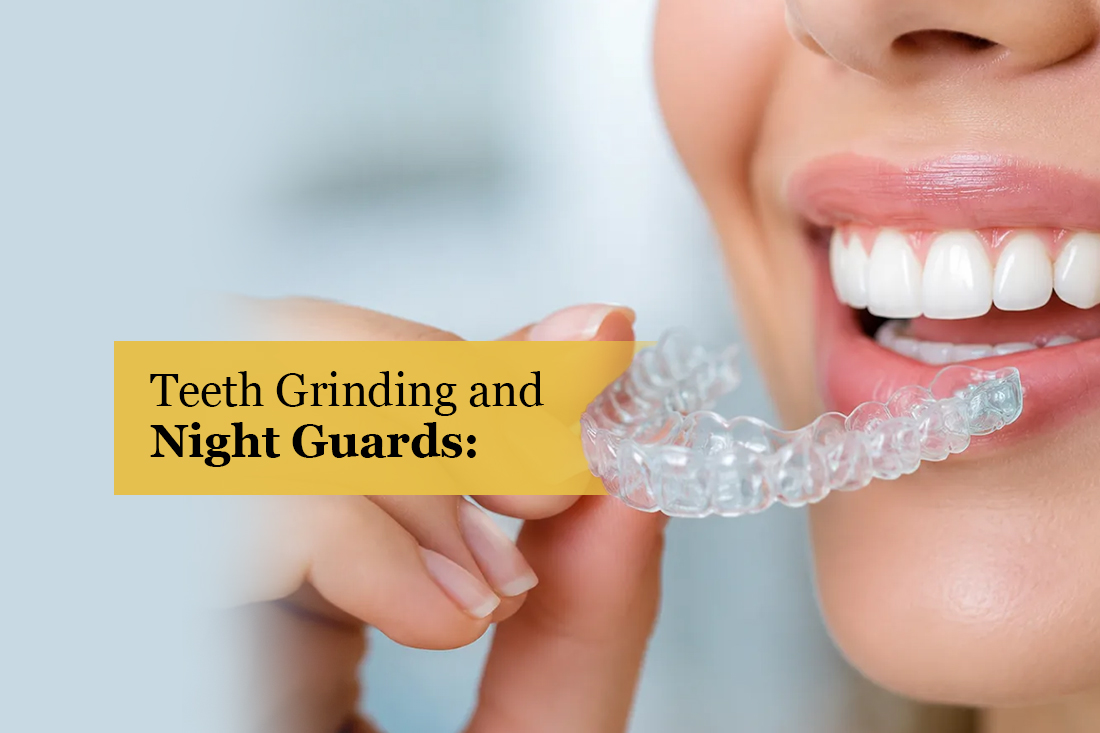
Teeth Grinding and Night Guards: What the Evidence Actually Says
 By Dr. Kanak Trivedi, DDS
Sep 08, 2026 · 5 min read
By Dr. Kanak Trivedi, DDS
Sep 08, 2026 · 5 min read
Waking with a sore jaw or worn teeth? Here is what causes grinding, what a night guard can and cannot do, and when it is worth getting one made.
Most people who grind their teeth do not know they do. The information usually arrives second-hand: a partner mentions the noise, or a dentist points out wear on teeth you thought were fine.
What follows is normally a recommendation for a night guard. It is a sound recommendation, but it is worth understanding what one actually does, because the honest answer is more limited than the marketing suggests, and more useful.
What bruxism is
Bruxism is clenching or grinding the teeth. When it happens during sleep it is called sleep bruxism; it also occurs while awake, often during concentration or stress, and that version tends to be more clenching than grinding.
The cause is not one thing. The research describes it as multifactorial, with both physical and psychological contributors. Stress and anxiety are commonly involved. So are sleep disorders, some medications, alcohol and caffeine, and the way the teeth meet.
That matters, because a single-cause explanation usually leads to a single-fix expectation, and this is not a condition that works that way.
How to tell whether you grind
- Waking with a tight, tired or aching jaw, particularly in the morning.
- Headaches concentrated around the temples on waking.
- Teeth that are visibly flattened, chipped at the edges, or shorter than they used to be.
- Increased sensitivity, especially first thing.
- Clicking, popping or restricted movement in the jaw joint.
- A partner who hears grinding at night.
- Scalloped edges along the sides of the tongue, or a ridged line along the inside of the cheek.
- Restorations that keep chipping or coming loose for no obvious reason.
A dentist can often confirm it from the wear pattern alone, because grinding produces flat, polished facets that meet precisely when the jaw is moved sideways. It looks quite different from ordinary wear.
Why it is worth addressing
Enamel does not regenerate. Wear from years of grinding is permanent, and severe cases end up needing extensive restorative work to rebuild lost tooth height.
Grinding also loads crowns, veneers and fillings well beyond normal chewing forces, which is why restorations fail early in people who grind. And there is an association with the jaw joint: sleep bruxism has been linked in the literature with degenerative changes in the temporomandibular joint, with pain, stiffness, reduced movement and clicking.
What a night guard does, honestly
A night guard, properly called an occlusal splint, is a custom-fitted appliance worn over the teeth during sleep.
Here is the part that is often overstated. The evidence that occlusal splints actually stop or cure sleep bruxism is not strong. Reviews have concluded there is insufficient evidence to say splints treat sleep bruxism, and that they are not clearly superior to other approaches such as physiotherapy for jaw disorders.
What they reliably do is protect. The splint takes the wear instead of your teeth. As one review dryly observes, the large replacement market for chewed-up splints is itself evidence that their role is protective rather than curative.
That is not an argument against getting one. It is an argument for the right expectation: a night guard is a seatbelt, not a cure. It prevents damage while you address whatever is driving the grinding.
Custom-made versus off-the-shelf
Pharmacy boil-and-bite guards are cheap and can be a reasonable short-term measure. Their drawbacks are real: they are bulkier, less comfortable, and therefore more likely to be abandoned after a fortnight. A poorly fitting guard can also alter how the teeth meet.
A custom guard is made from an impression or scan of your own teeth, is thinner and better retained, and is designed so the bite meets evenly across it. It costs more. The main practical advantage is that people actually wear it, which is the only feature that matters.
If you wear one, bring it to your checkups. The pattern of wear on the guard tells your dentist how much grinding is going on and whether it is changing.
What else actually helps
Because bruxism is multifactorial, protection alone is rarely the whole plan:
- Address sleep quality. Grinding is associated with disrupted sleep, and snoring or daytime exhaustion alongside grinding is worth mentioning to your physician.
- Look at stress and routine, particularly in the hour before bed.
- Reduce alcohol and late caffeine, both linked with more disturbed sleep and more grinding.
- Notice daytime clenching. Many people clench at a screen without realising. Keeping teeth slightly apart at rest is a habit that can be relearned.
- Review medications with your doctor if grinding started after a change.
- Have uneven bites adjusted where a specific high spot is identified.
When to get it looked at sooner
Book sooner rather than waiting for a routine visit if your jaw locks open or shut, if pain is persistent rather than occasional, if you cannot open as wide as you used to, or if teeth are visibly chipping. Those suggest the joint or the teeth are already being affected.
Keep reading