Inlays and Onlays: The Middle Ground Between a Filling and a Crown
When a cavity is too big for a filling but the tooth does not need a crown, an inlay or onlay may be the answer. Learn how they work, what they cost, and how long they last.
Not every damaged tooth fits neatly into "filling" or "crown." When decay or an old filling has removed a large portion of a back tooth but the walls are still sound, an inlay or onlay restores the tooth while keeping more of your natural structure than a crown would. They are made in a laboratory or milled in the office and then bonded to the tooth.
Real Dentistry uses inlays and onlays as part of restorative dentistry in Fullerton. Here is how to tell whether one might suit you.
What they are
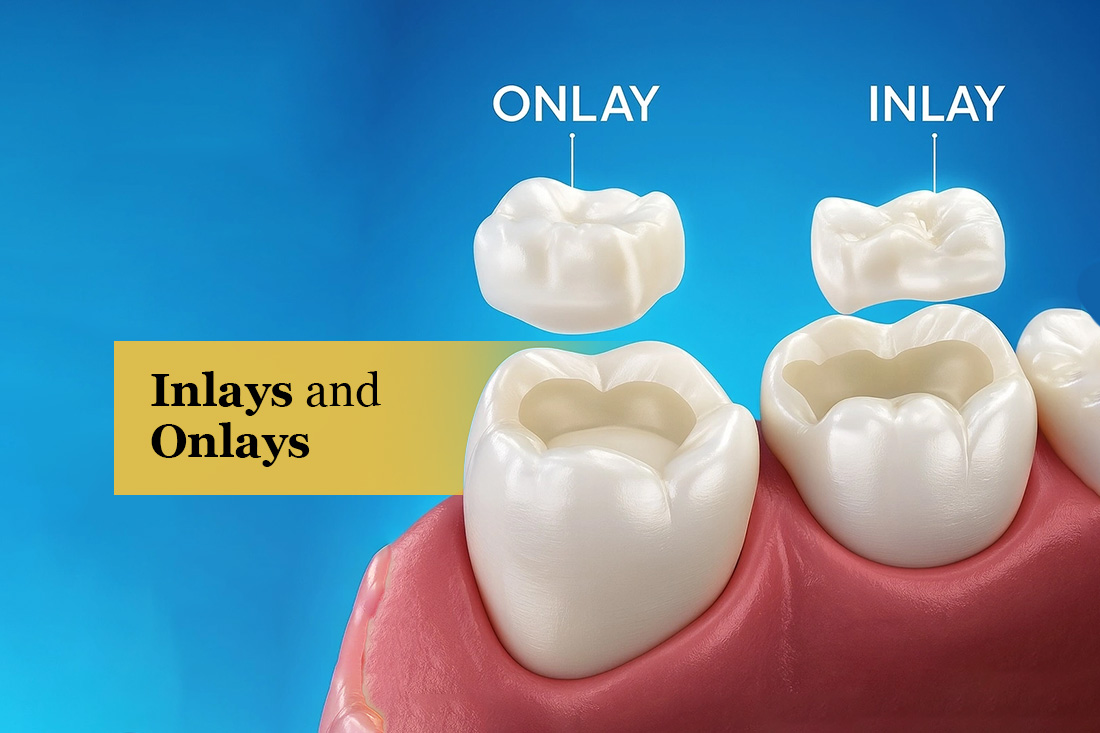
An inlay fits within the cusps, the raised points on the chewing surface of a molar or premolar. An onlay extends over one or more cusps, replacing a part of the tooth that would otherwise be too weak. Both are custom-made from porcelain, composite resin, or gold, and both are sometimes called partial crowns. The ADA fillings overview describes these indirect restorations.
Filling, inlay, onlay, or crown
- Filling: small to medium cavities. Placed directly in one visit.
- Inlay: a medium cavity where a direct filling would be weak, but the cusps are intact.
- Onlay: one or more cusps are cracked or missing, but enough tooth remains to avoid a full crown.
- Crown: the tooth is extensively broken down, has had a root canal, or needs full coverage for strength.
Benefits
Inlays and onlays preserve more healthy tooth than a crown, which requires reshaping the whole tooth. Porcelain versions match the surrounding teeth closely and resist staining. Because they are made outside the mouth, they fit precisely and seal well at the edges, which helps prevent new decay. They are also strong enough for the heavy chewing forces on back teeth.
The appointments
At the first visit the dentist removes decay and old filling material, shapes the tooth, and takes an impression or digital scan. A temporary restoration protects the tooth while the lab makes the final piece. At the second visit, usually one to two weeks later, the inlay or onlay is checked for fit and bite and bonded in place. Some practices can mill the restoration the same day.
Cost and lifespan
Inlays and onlays cost more than a filling and about the same as or slightly less than a crown. Many dental plans cover them as a basic or major restoration; the office can check your benefits. With good care they typically last 10 to 20 years, longer than most large direct fillings.
Restorative care in Fullerton
Learn about fillings, crowns, and onlays at Real Dentistry. Request an appointment or call (714) 525-2888 to have a damaged tooth assessed.
Keep reading