
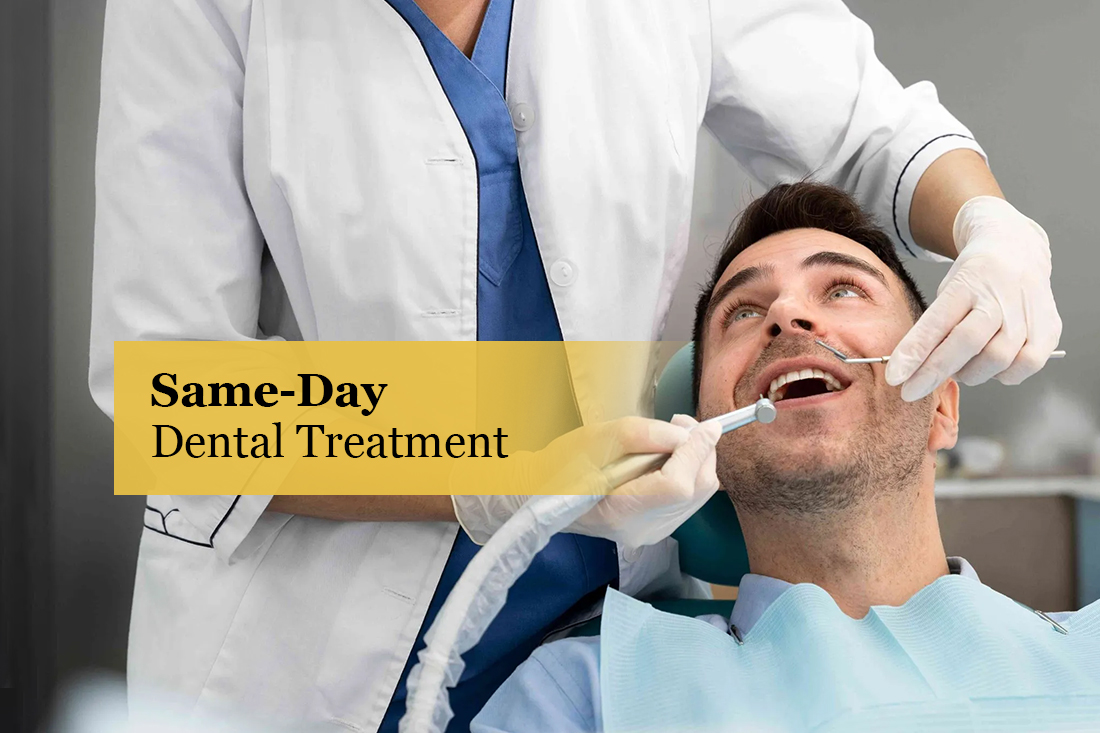
Same-Day Dental Treatment: What Can Realistically Be Done in One Visit
 By Dr. Kanak Trivedi, DDS
Sep 12, 2026 · 5 min read
By Dr. Kanak Trivedi, DDS
Sep 12, 2026 · 5 min read
Which dental problems can genuinely be fixed in a single appointment, which cannot, and what to ask when you call. A realistic guide for Fullerton patients.
Taking time off for dental appointments is one of the quiet reasons people delay treatment. Two visits for a crown means two mornings, two commutes and two lots of childcare, and that is before anything unexpected happens.
So the question is a practical one: what can genuinely be finished in a single appointment, and what cannot? Here is an honest answer, because being promised a one-visit fix and needing three is worse than being told the truth up front.
What is usually achievable in one visit
- Fillings, including tooth-coloured composite fillings.
- Simple extractions.
- Emergency pain relief, including opening and draining an infected tooth to settle it.
- Re-cementing a crown that has come off intact.
- Repairing a chipped front tooth with composite bonding.
- Adjusting a denture or a night guard that has become uncomfortable.
- Examinations, X-rays and a cleaning, when there is time available.
These share one feature: they do not depend on anything being manufactured elsewhere.
Crowns in a single visit
Traditionally a crown takes two appointments because the crown is made in a laboratory while you wear a temporary. Practices equipped with chairside CAD/CAM technology can scan the prepared tooth, design the crown on screen and mill it from a ceramic block on site, which collapses the process into one longer appointment.
It is reasonable to ask how these compare clinically. Research on chairside CAD/CAM restorations reports fewer appointments and less chair time, more conservative treatment of the remaining tooth structure, and clinical longevity comparable to conventional laboratory crowns. One systematic review found somewhat higher rates of aesthetic complications with CAD/CAM manufacturing, and other work suggests survival relates more to the ceramic material chosen than to whether the crown was milled in the practice or made in a laboratory.
Put simply, a same-day crown is a genuine option rather than a compromise, but it is equipment-dependent. Not every practice has a mill, so this is worth asking about specifically rather than assuming.
Whether single-visit milled crowns are available at any given practice depends on its equipment. Ask when you book rather than assuming from the phrase "same-day treatment", which is often used more broadly.
What cannot be rushed, and should not be
- Dental implants. The implant needs months to integrate with the bone before the final tooth goes on. Same-day temporary teeth exist in some cases, but the finished result is not a one-visit treatment.
- Orthodontics and clear aligners, which work by moving teeth gradually.
- Laboratory-made dentures and bridges, which require impressions, try-ins and adjustment.
- Most root canal treatment followed immediately by a permanent crown. The root canal itself can often be completed in one visit; the crown usually follows separately.
- Gum disease treatment, which is staged deliberately and reviewed afterwards.
A practice that promises any of these in a single visit is either describing a temporary solution or overselling.
Same-day treatment and same-day appointments are not the same thing
These two phrases get used interchangeably and mean different things.
A same-day appointment means you can be seen today, usually because time is held back for urgent cases. That is about access. Same-day treatment means the work itself is finished in that visit. That is about what is clinically and technically possible.
When you call in pain, the first matters most. Being seen, diagnosed and made comfortable today is the priority, even if the definitive repair happens later that week.
What to ask when you book
- Can I be seen today, and roughly how long will the appointment be?
- Is it likely the problem can be finished in that visit, or should I expect a follow-up?
- If it cannot be finished, what will be done today to make it comfortable?
- Do you make crowns on site, or are they sent to a laboratory?
- What will today cost, and what would the full course cost?
A practice that answers the second and third questions clearly is being straight with you. Treatment that depends on what is found once work begins genuinely cannot be quoted precisely over the phone, and a careful answer is a good sign rather than evasion.
A realistic expectation
For most everyday problems, one visit is achievable. For anything involving healing, growth or laboratory work, it is not, and the timeline exists for a reason. The useful thing to know is that even when the full repair takes longer, getting out of pain almost never has to wait.
Keep reading