
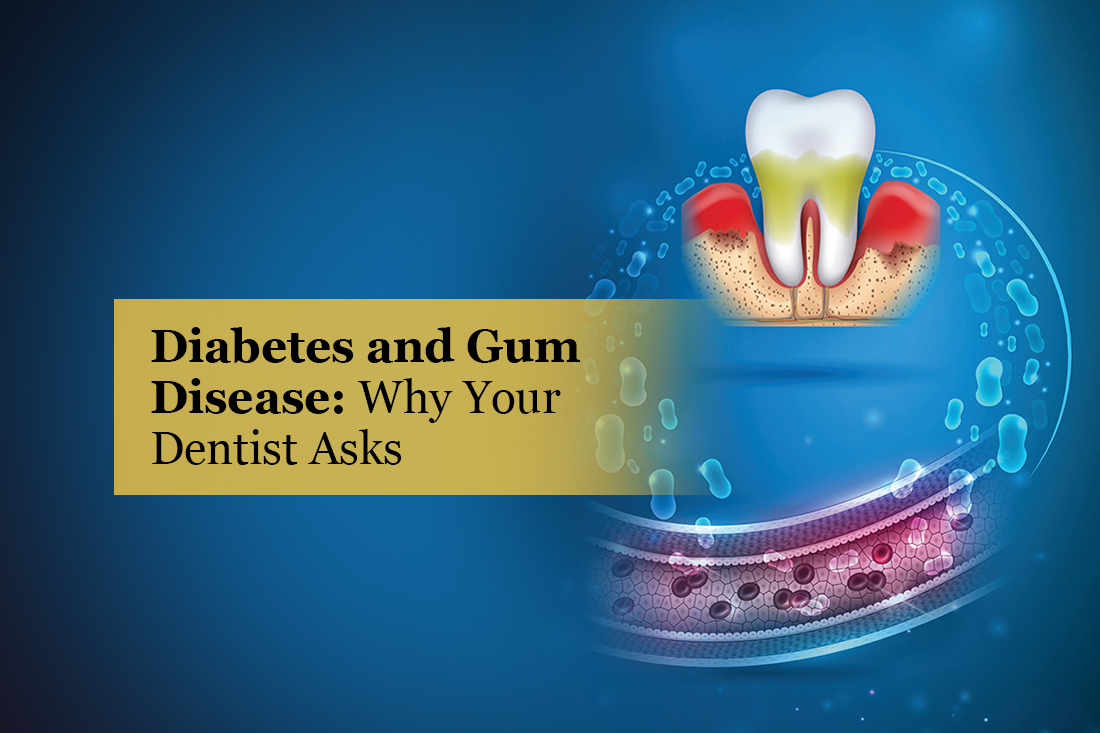
Diabetes and Gum Disease: Why Your Dentist Asks About Your Blood Sugar
 By Dr. Kanak Trivedi, DDS
Sep 19, 2026 · 5 min read
By Dr. Kanak Trivedi, DDS
Sep 19, 2026 · 5 min read
Diabetes raises your risk of gum disease, and gum disease can make blood sugar harder to control. Here is what the research shows and what to do about it.
If you have diabetes, you have probably been asked about it at the dentist and wondered why it is any of their business. It is a reasonable question with a specific answer: the relationship between diabetes and gum disease runs in both directions, and each one makes the other harder to manage.
This is one of the better-evidenced links between oral health and general health, so it is worth understanding properly rather than vaguely.
Direction one: diabetes raises the risk of gum disease
People with diabetes are more susceptible to periodontitis, the advanced form of gum disease in which the bone supporting the teeth is lost. Research reviewing the relationship has put that increase at roughly threefold.
The National Institute of Dental and Craniofacial Research lists diabetes among the established risk factors for gum disease, alongside smoking, age, genetics and stress.
There is also a dose relationship. The evidence points to a link between how elevated blood glucose has been and how severe the gum disease becomes, which means control matters, not simply whether you have a diagnosis.
Direction two: gum disease makes blood sugar harder to control
This is the half most patients have never been told. Periodontitis is a chronic inflammatory condition. That inflammation does not stay politely inside the mouth, and it appears to worsen glycaemic control in people with diabetes.
The encouraging part is what happens when the gum disease is treated. Studies of non-surgical periodontal treatment, which is essentially the deep cleaning described elsewhere on this blog, have found associated improvements in glycaemic control, with reductions in HbA1c of roughly 0.4 percentage points reported in the literature.
That is not a replacement for diabetes management, and no dentist should present it as one. It is a meaningful contribution from an intervention most people did not realise was on the table.
What this looks like day to day
Diabetes can show up in the mouth in several ways, and recognising them early is useful:
- Gums that bleed, swell or feel tender, particularly if this is new.
- A dry mouth, which reduces saliva and therefore reduces your natural defence against decay.
- Infections that are slower to settle than you would expect.
- Fungal infections such as oral thrush.
- Changes in taste, or a persistent bad taste.
None of these is exclusive to diabetes. Together, and especially alongside a known diagnosis, they are worth mentioning at your next appointment rather than waiting.
Why your dentist asks, specifically
When a dental team asks about your diabetes, they are usually after three things. Whether you have it at all, because it changes what they look for. How well controlled it currently is, often by asking about your most recent HbA1c. And whether anything has changed recently, such as a new medication.
It changes practical decisions too, including how often you are seen, how closely gum measurements are monitored, and how healing is expected to go after any procedure.
What actually helps
The advice here is unglamorous and it works:
- Tell your dental team about your diagnosis and your latest numbers. It is clinical information, not a confession.
- Expect a shorter recall interval. Being seen three or four times a year rather than twice is common and sensible when risk is higher.
- Treat bleeding gums as a finding rather than a nuisance. Bleeding is inflammation, and inflammation is the mechanism in both directions.
- Keep the daily routine consistent: brushing twice with fluoride toothpaste and cleaning between the teeth once a day.
- If you smoke, this is the combination where stopping pays the largest dividend. Smoking is the single most significant risk factor for gum disease.
- Mention dry mouth. It is manageable, and it is a decay risk that is easy to miss.
Telling your two care teams about each other
Diabetes care and dental care are usually delivered by people who never speak to each other, and patients end up as the link between them. It is worth being that link deliberately.
Mention at your dental appointment that you have diabetes and how it is being managed. Mention at your medical appointment if your gums bleed or you have been told you have gum disease. Neither conversation takes long, and each gives the other clinician information they would not otherwise have.
The point to take away
Gum disease is common, largely painless until it is advanced, and more likely if you have diabetes. It is also treatable, and treating it may help with the thing you are already working hard to control. That makes a gum examination one of the more worthwhile appointments in the calendar.
Keep reading