
Deep Cleaning vs Regular Cleaning: What's the Difference?
 By Dr. Kanak Trivedi, DDS
Sep 22, 2026 · 5 min read
By Dr. Kanak Trivedi, DDS
Sep 22, 2026 · 5 min read
Told you need a deep cleaning? Here is how scaling and root planing differs from a routine clean, what it costs you in time, and why it was recommended.
There is a particular moment that makes patients uneasy: you went in expecting a routine cleaning, and you were told you need a deep cleaning instead. It sounds like an upsell. Often the appointment ends before anyone has explained why.
The difference between the two is not effort or thoroughness. It is depth, and it is measurable.
The measurement that decides it
Your gum is not fused to your tooth. There is a shallow cuff where the two meet, and during an examination your dentist measures how deep that cuff goes at several points around each tooth.
When gums are healthy, those readings are shallow and consistent, and a routine clean can reach the bottom of them. When inflammation persists, the attachment breaks down and the cuff deepens into what is called a pocket. A deeper pocket holds bacteria and hardened deposit below the level an ordinary cleaning instrument can reach or clean properly.
So the recommendation is not a judgement about how well you brush. It is a response to a number. If you want to understand it, ask to see your readings and ask which teeth the deep readings are on. Any dentist should be glad to show you.
What a regular cleaning does
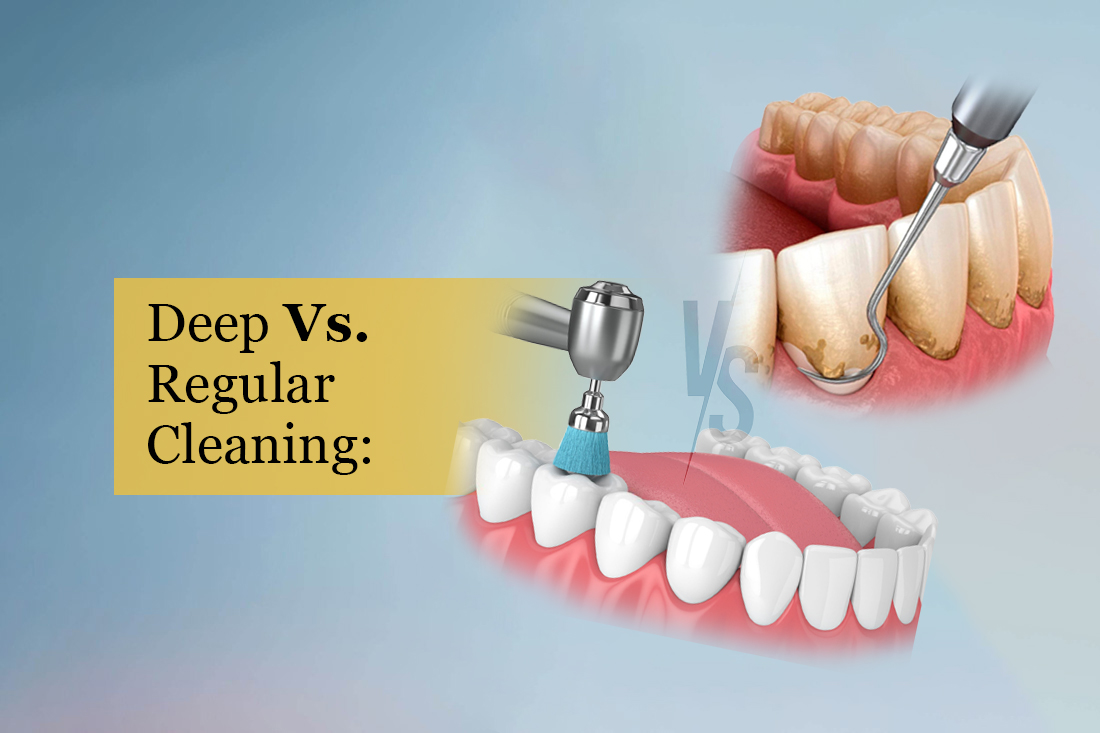
A routine cleaning, sometimes called a prophylaxis, works on the crown of the tooth and just under the gumline. It removes plaque and hardened tartar from surfaces that are accessible, polishes the tooth, and finishes with flossing and often fluoride.
It is a preventive appointment. It is designed to keep healthy gums healthy, and it usually takes a single visit of under an hour.
What a deep cleaning does
A deep cleaning is properly called scaling and root planing. The National Institute of Dental and Craniofacial Research describes it as the standard non-surgical treatment for established gum disease.
Scaling removes plaque and tartar from the tooth surface and from inside the pocket, below the gumline. Root planing then smooths the root surface itself, because a rough, contaminated root gives bacteria somewhere to hold on and makes it harder for the gum to reattach.
Three things make it a bigger appointment than a routine clean:
- It is usually done with local anaesthetic, because the instruments work below the gumline.
- It is often split across two visits, treating one side of the mouth at a time.
- It is followed by a review appointment to re-measure the pockets and see whether they have improved.
That last point is the part patients most often miss. The treatment is not really finished on the day. It is finished when the follow-up measurements show the gum has responded.
Side by side
- Purpose: a regular cleaning prevents disease; a deep cleaning treats it.
- Depth: a regular cleaning works at and just below the gumline; a deep cleaning works inside the pocket and on the root.
- Anaesthetic: rarely needed for a routine clean; commonly used for a deep clean.
- Time: one short visit, against one or two longer visits plus a review.
- Afterwards: back to your usual interval, against a shorter maintenance interval for a while.
What it feels like, and what comes after
During the appointment, the numbing means you should feel pressure and vibration rather than pain. Afterwards, it is normal for the gums to be tender for a few days and for teeth to feel temporarily more sensitive to cold, because root surfaces that were covered by inflamed tissue are now exposed to the mouth.
That sensitivity usually settles. A desensitising toothpaste helps in the meantime, and the gum tightening back against the tooth is a sign the treatment is working rather than a complication.
You will normally be placed on a shorter recall for a while, often three or four months rather than six. Gum disease is managed rather than cured, and the interval reflects that.
What happens if you decline it
This is a fair question and deserves a straight answer. Gum disease is usually painless in its early and middle stages, so declining treatment does not feel like anything at the time.
What continues underneath is the loss of the bone and attachment holding the tooth in place, and that loss does not come back on its own. The CDC lists gum disease with associated bone loss among the leading causes of tooth loss in adults, alongside decay and smoking. Treating it early is far less involved than replacing a tooth later.
A reasonable way to respond
If you are unsure, you do not have to say yes on the spot. Ask to see your pocket measurements, ask which teeth are affected, ask what the plan is if the follow-up shows improvement, and ask what it will cost in total including the review. Those four questions will tell you quickly whether the recommendation is well founded.
Keep reading