
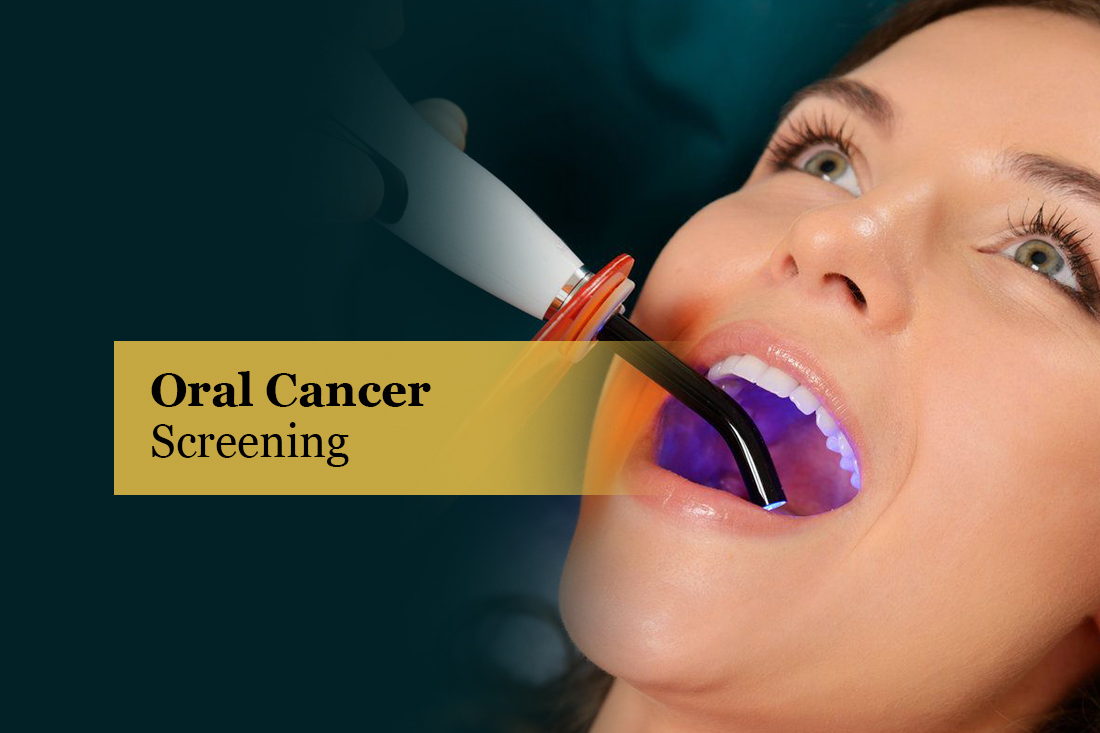
Oral Cancer Screening: What It Involves and Who Should Have One
 By Dr. Kanak Trivedi, DDS
Sep 17, 2026 · 5 min read
By Dr. Kanak Trivedi, DDS
Sep 17, 2026 · 5 min read
An oral cancer screening takes a couple of minutes and is painless. Here is exactly what your dentist checks, what they are looking for, and who is most at risk.
Oral cancer screening is the part of a dental appointment most patients never notice. It takes a couple of minutes, involves looking and gently feeling rather than any instrument, and often happens before the cleaning has even started.
Because it is quiet and quick, it rarely gets explained. It is worth understanding, because this is a cancer where catching it early makes a substantial difference and where the person most likely to spot it first is your dentist.
How common is it?
The American Cancer Society estimates about 60,480 new cases of oral cavity or oropharyngeal cancer in the United States for 2026, and about 13,150 deaths.
The median age at diagnosis is 64, but this is not exclusively a disease of older adults: just over one in five cases occurs in people younger than 55. Lifetime risk is estimated at about 1 in 59 for men and 1 in 139 for women.
Those are national figures rather than predictions about any individual. The useful takeaway is that the condition is uncommon but not rare, and that a short routine check is a proportionate response.
What your dentist actually does
A screening is a systematic look at every soft-tissue surface in and around the mouth, followed by feeling for anything that should not be there. In practice that means:
- Looking at your lips, inside and out, and the corners of the mouth.
- Checking the inside of both cheeks.
- Examining the tongue on top, underneath, and along both edges, which usually means holding it gently with gauze to see the sides properly.
- Looking at the floor of the mouth beneath the tongue, and the roof of the mouth.
- Looking at the back of the throat and the tonsil area.
- Feeling under the jaw and along the neck for enlarged lymph nodes.
The underside and edges of the tongue and the floor of the mouth get particular attention, because they are common sites and because you cannot easily see them yourself.
What they are looking for
Your dentist is looking for anything that is new, one-sided, or has not healed. Specifically:
- A sore or ulcer that has not healed within about two weeks.
- A white or red patch that cannot be wiped away.
- A lump or thickened area in the cheek, tongue or neck.
- An area that bleeds without an obvious cause.
- Numbness, persistent soreness, or a feeling that something is caught in the throat.
- Difficulty moving the jaw or tongue, or ongoing difficulty swallowing.
Most findings turn out to be harmless. Cheek bites, ulcers from a sharp filling and irritation from a denture edge are all common and all look alarming to the person they belong to. The question is not whether something looks unusual on one day, but whether it is still there two weeks later.
Who is most at risk
The main recognised risk factors are tobacco in any form, heavy alcohol use, and infection with human papillomavirus, which is associated in particular with cancers at the back of the mouth and throat. Sun exposure is a risk factor for cancers of the lip. Risk rises with age, and tobacco and alcohol together raise it more than either alone.
That said, cases do occur in people with none of these, which is exactly why the check is routine for everyone rather than only for those who look high-risk on paper.
What happens if something is found
Usually the first step is simply to wait and look again. Many sore spots are traumatic, and a two-week review tells you a great deal. If there is an obvious local cause, such as a sharp edge on a tooth, that gets fixed first and the area reviewed after.
If an area persists, looks suspicious, or has no clear explanation, you would be referred for specialist assessment and possibly a biopsy, which is the only way to know for certain. Being referred is not the same as being diagnosed. It is the system doing what it is supposed to do.
What you can do between appointments
You see your own mouth more often than anyone else does. Once a month, in good light, look at your lips, cheeks, tongue including the underside and edges, and the floor of your mouth. You are not diagnosing anything, only noticing change.
The rule worth remembering is the two-week rule: anything that has not healed in two weeks deserves a professional look. Do not wait for your next scheduled visit, and do not wait for it to hurt. Many early lesions are painless, which is exactly why they get ignored.
The short version
It takes two minutes, it does not hurt, and it is included in a routine appointment. Ask your dentist to talk you through it while they do it. Knowing what is being checked makes it far more likely you will notice something yourself in the eleven months of the year you are not in the chair.
Keep reading